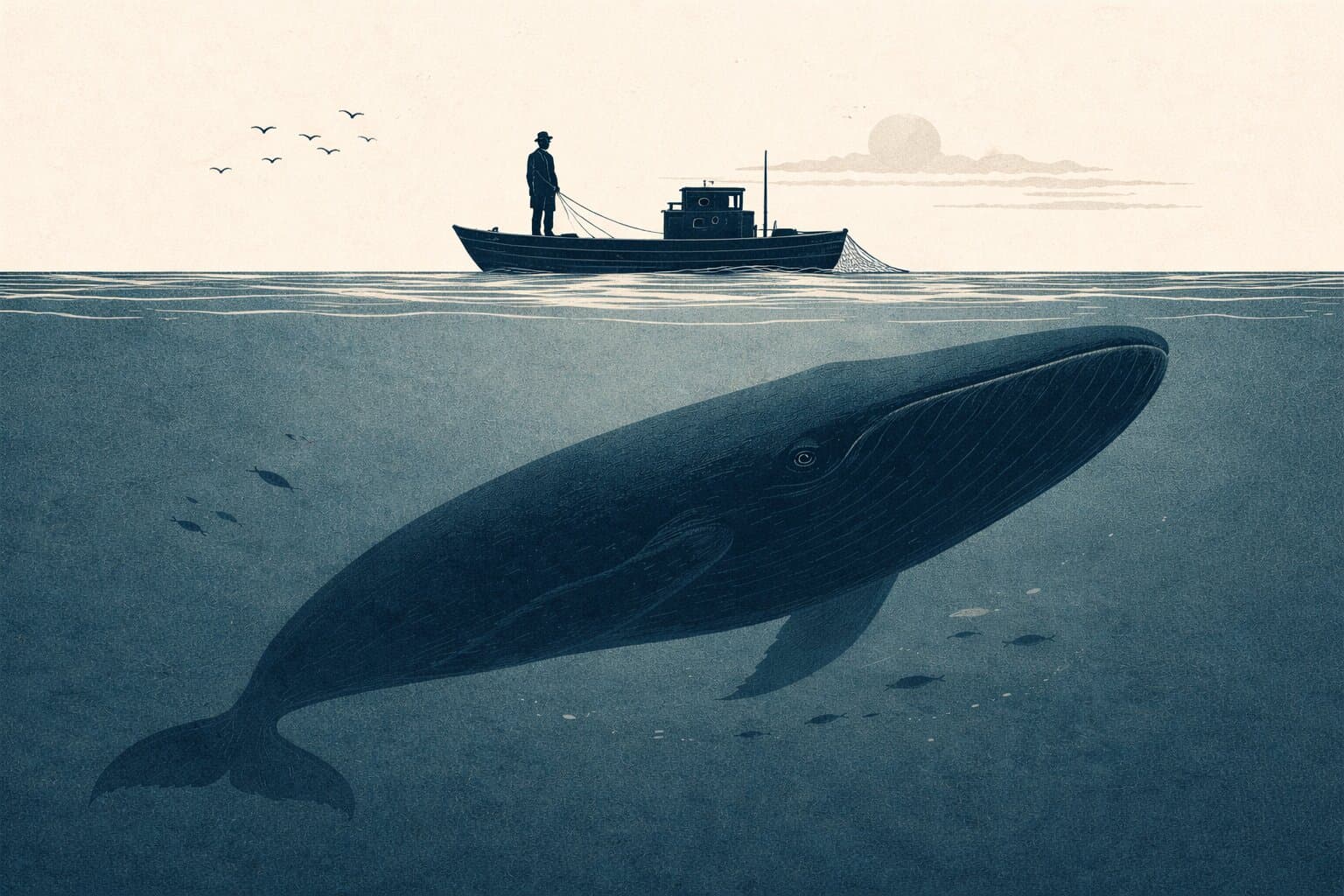
Despite struggling with this thought throughout the (enchanting) reading, The Leviathan is ultimately a story about faith. It is a faith that acts like a bellows, filling the believer with spirit and allowing him to fly vast distances. It is difficult to understand or accept the sheer level of fantasy that saturates the end of the story otherwise.
Nissen Piczenik’s faith in the vitality of the corals he trades, in the immense Leviathan that guards them at the bottom of the sea, and in Yahweh, who appointed him as their guardian, exists alongside his identity as a craftsman—a merchant—and moreover, as someone who has never ventured beyond the borders of his small town. This fusion between craftsman and believer is, in my eyes, one of the primary sources of the story’s magic.
Although in some sense Nissen’s craft goes hand in hand with his faith—after all, he trades in the very corals whose vitality he believes in—it is also riddled with contradictions. The first and most obvious is that Nissen trades in his craft; therein lies an oxymoron. His profession does not encourage him to deepen his faith but rather to profane it, to sell it and haggle over it, turning his profound belief in "the depths" into a mundane, earthly matter.
It is not without reason that customers interacted differently with Nissen, and he with them. He treated them as friends, even if not out of total innocence. There was a serenity in him, unlike that of a typical merchant, which he projected onto his buyers. Yet, he was well-versed in all the tricks and deceptions of the trade, whether they came from him or his customers. His pure faith was constantly being soiled.
Here, the second contradiction enters—Nissen’s indifference, or rather, his dreaminess. Nissen’s faith is not "devout" in the sense of being a slave to its commandments; therefore, it does not instill in him a burning piety toward his work. He is not a fanatic trying to see his trade as the embodiment of the holiness he believes in.
On the contrary, for him, faith is akin to a dream—he wants to see the sea! It is an entire world missing from his mind but existing in his soul. It does not instill in him material productivity, but rather a sense of wandering thought. How is it possible for someone so skilled in his work to have his head in the clouds, or submerged in the depths?
Something about this "Psycho-Physical Problem," as Leibowitz called it, emphasizes the charm of Nissen’s faith. It simply does not settle. The material world, the Public Domain (Reshut HaRabim), along with the spiritual world, Nissen’s Private Domain (Reshut HaYachid), do not seem to coexist, and yet the miracle known as Nissen Piczenik occurs on this earth. The Leviathan, which gave the story its title, is the embodiment of the earthly element that contains the miracle within it.
Nissen, as mentioned, never left his small town. Like the heroes of Sholem Aleichem or Gogol, he is slightly ridiculed for this. He was even taunted by the pearl merchant who travels between lands. Nissen appears like a piece of ancient amber suddenly revealed before our eyes; like coral pulled from the sea. His private world is meager. He is indifferent to his barren wife and focuses solely on his trade.
Therefore, when the young sailor arrives, Nissen’s faith receives a rare opportunity to take shape in reality. This ecstasy highlights his ignorance and smallness, but because of them, it highlights his passion, his occasionally conscious dreaminess, and the miracle—which Nissen has believed in all his life.
Immediately after the miracle touched his private life and departed, Nissen’s life was left devoid of wonder, and for the first time—that is how he perceived it. The wife to whom he was indifferent became hated; his craft was no longer a point of interest, and he fell for every deception he once knew by heart. Nissen sought the miracle—and traveled to the sea. For one moment, Nissen met the sublime—his faith taking on flesh and blood—and now he stood on the other side of the psycho-physical problem.
Now, reality began to gnaw at the miracle—it created a mimicry, a mask. A competitor arose—a merchant of artificial corals. And they appeared far better than Nissen’s "living" corals. The world sought to buy the artificial, and Nissen sold his faith.
It is no coincidence that this decision is described as being influenced by the devil; Nissen betrayed the miracle—the sublime that merges with reality through wonder. Out of a desire not to part with his living corals, he began to weave the living and the artificial together—and instead of a simple fraud, he created an illusion, for others and for himself.
This is how his punishment can be understood. A customer of Nissen’s, to whom he sold a coral necklace, fell ill and died, and a foul rumor spread about his corals. The punishment is not the rumor itself, but that he was left without any ability to resist it. And so, throughout the time Nissen was boycotted and his business deteriorated—he remained silent. He could not defend a superstition with another superstition.
Reality surprised him, and he no longer possessed enough faith to respond to it. The connection between the two worlds was severed. Unable to live here or there, neither in deceit nor in honesty, Nissen sought the miracle once more—and united with it. In dreaminess, in innocence, and likely in helplessness. He was enchanted, and nothing in his reality had enough strength to hold him.
The rumors say that Nissen jumped into the sea.